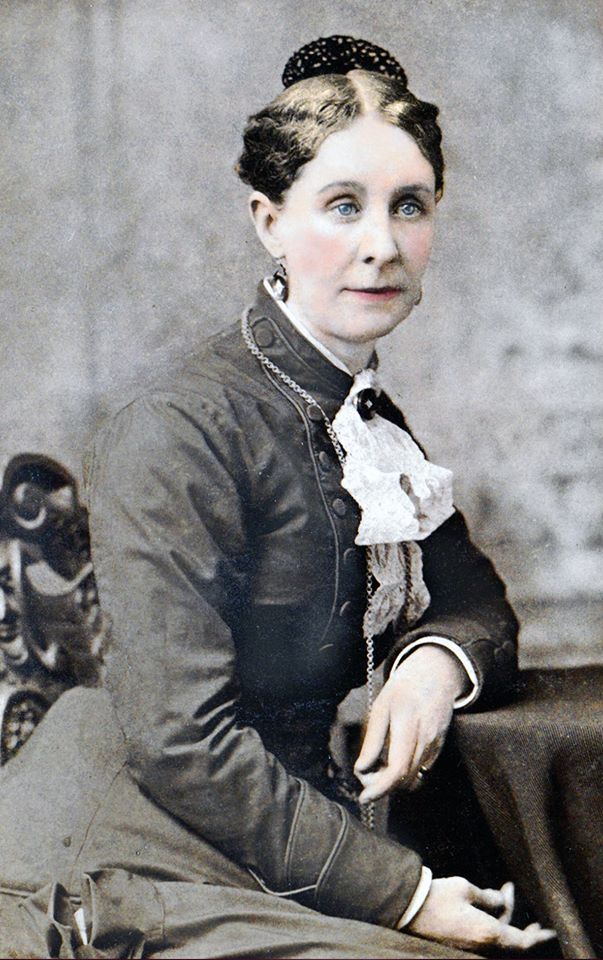
MRS. J.E.B. STUART, 1st CHAPTER PRESIDENT
Flora Cooke Stuart (1836-1923), was J.E.B. Stuart’s wife, and even after the Confederate General’s death, Flora remained Stuart’s champion for the next 59 years. Flora Cooke seemed to be the perfect match for the future Confederate Icon, as she was beautiful, both inside and out, sang like a bird, played guitar, could out ride most men, and was a crack shot with both a rifle and pistol. She could be feisty, yet coy, and being the commanding officer’s daughter, made her quite the prize catch.
“Never in her eighty-eight years of life did she feel the need to wear any sort of makeup. J.E.B. Stuart, Confederate General, was more than charmed; he was smitten.”
Flora’s Early Life
Flora Cooke was born on January 3, 1836, at Jefferson Barracks, outside St. Louis, Missouri. Her father, General Philip St. George Cooke, was a native of Virginia, while her mother, Rachel Hertzog Cooke, was born and raised in Philadelphia, Pennsylvania. Flora the second of four children, spent her formative years at various army forts where her father was the commanding officer and eventually was enrolled in a boarding school at Detroit, Michigan.
Flora graduated in 1855 and planned first to visit her parents at Fort Riley in the Kansas Territory, where her father was commander, and with her next stop, Philadelphia for her coming out gala and social introductions. Flora’s father, however, had arranged a grand review in his daughter’s honor and the young maiden’s equestrian prowess so enraptured a young lieutenant, J.E.B. Stuart, that a courtship soon followed. Before leaving on assignment at Fort Leavenworth, Lieutenant Stuart asked General Cooke for his daughter’s hand in marriage.
Flora Cooke, wearing her graduation dress, married Lieutenant Stuart on November 14, 1855, at Fort Riley in the Kansas Territory. The young couple honeymooned with Stuart’s family in Virginia and made their home in Kansas until 1859, when the Stuarts returned to Virginia where Flora’s husband served as a volunteer aide to Robert E. Lee who, in October of 1859, was ordered to Harper’s Ferry to suppress John Brown’s insurrection.
Flora’s Life during the War Between the States
When Virginia seceded from the Union and after eleven years in the service of the United States Army, Stuart resigned and joined The Confederate States of America, saying, “From a sense of duty to my native state, I hereby resign my position as an officer in the Army of the United States. Most respectfully, Sir, Your obt. svt. J.E.B. Stuart”
J. E. B. Stuart arranged to enter Confederate military service and moved his family to Wytheville, Virginia. To his disappointment, Flora’s father, Philip St. George Cooke, chose not to resign his U.S. Army commission
Flora tried to stay near her husband’s camp, where they could keep each other company. Their marriage could become strained especially when Stuart wrote letters to varied women, as his fame grew. These missives to other females created a rift between the young couple, even if J.E.B. discounted his intent. Flora disliked the photographs and other gifts these admirers sent and wrote of feeling laughed at for her “husband’s fondness for society and the ladies.” Most of J. E. B. Stuart’s contemporaries felt that he was a thoughtful and romantic husband, carrying his wife’s photograph near his heart, although he told her he did “not need it my love, to keep you ever vividly before me.”
Flora’s Losses
The Stuarts had three children, two girls and a boy. The boy was named Phillip St. George at birth for Flora’s father, but Jeb was so upset by his father-in-law remaining with the Union that he had his wife change the boy's name. Stuart to wrote his wife that it would do “irreparable injury to our only son” to have him named after Cooke, and after some deliberation, the couple renamed the boy James E. B. Stuart Jr.
On November 3, 1862, their daughter Flora died of typhoid fever. A friend of the family observed that the young mother was “not herself since the loss of her little companion, words could not describe the agony she had endured.” The birth of a daughter, Virginia Pelham, the following October both eased and intensified the loss. Flora Stuart lamented, “She is said to be like Little Flora, I hope she is.”
Just as Flora Stuart was recovering from the loss of her namesake and the birth of infant Virginia, she received a telegram on May 12, 1864, that her husband had been “seriously wounded” at the Battle of Yellow Tavern. Having seen her husband just two days earlier, Flora Stuart immediately traveled to Richmond, but J.E.B. Stuart had already passed and was to be buried at the Hollywood Cemetery in Richmond.
After only nine years of marriage, Flora at age 28, became a widow. And although this was a painful moment for her, she was lucky to have the support of her sister, brother-in-law, and close friends at this devastating moment. Better a situation like this, than to have her Confederate General die miles away alone on a battlefield. Despite her husband’s wishes, Flora Stuart would wear black for the rest of her life and find solace in referring to herself as Mrs. General Stuart.
Mrs. General Stuart’s Move to Staunton
Mrs. General Stuart’s husband had requested that she raise her children in the south, so she moved to Saltville and resided with J.E.B.’s brother, William Alexander Stuart and his family. The widow Stuart also opened a school in Saltville and in 1878 she moved to Staunton where she taught at a Methodist school. In 1880 she became principal of Staunton’s Virginia Female Institute, an Episcopal school for girls, until her retirement in 1899. Then in 1907, the Virginia Female Institute was renamed Stuart Hall in Flora Stuart’s honor.
Our J.E.B. Stuart United Daughters of the Confederacy Chapter was organized 23 Oct 1895, and Mrs. J.E.B. Stuart became its first President.
In 1898, following the death of her daughter Mrs. Virginia Stuart Waller, Mrs. General Stuart moved to Norfolk to help raise her three grandchildren. There, she surrounded herself with “many reminders of her honored husband, among them a flag, carefully framed, made by her own hands and carried at the head of his troops.”
“My heart, as must my name, remains in your misdst and all your interests will be mine too.”
Flora’s Death
Flora Stuart died on May 10, 1923, and was buried beside Confederate General J. E. B. Stuart and their daughter Flora, in Hollywood Cemetery, Richmond, Virginia on May 12, 1923, and the 59th anniversary of her husband’s death.
Flora Stuart was General J.E.B Stuart’s soul mate, but an example of the devotion and family values of an era of division and calamity that could endure in a woman who chose to be remembered as Mrs. General Stuart.
Source: Civil War Women According to Bummer by C. W. Maples